
Model of the month February 2026
Bodyguard: Focke-Wulf 190 D-9 of J.V. 44
From the original to the model
The more than 1,000 scale models, primarily in the international standards 1/72, 1/48 and 1/32, form an independent part of the collections of the Aviation Museum Hannover-Laatzen.
These true-to-life miniatures give visitors to the museum an overview of the history of technology, not only of individual exhibits (sometimes even as the only opportunity to see a real three-dimensional view if no original survives), but also of developments in aircraft design through the possibility of sequencing and comparison. Their craftsmanship alone is a delight to behold.
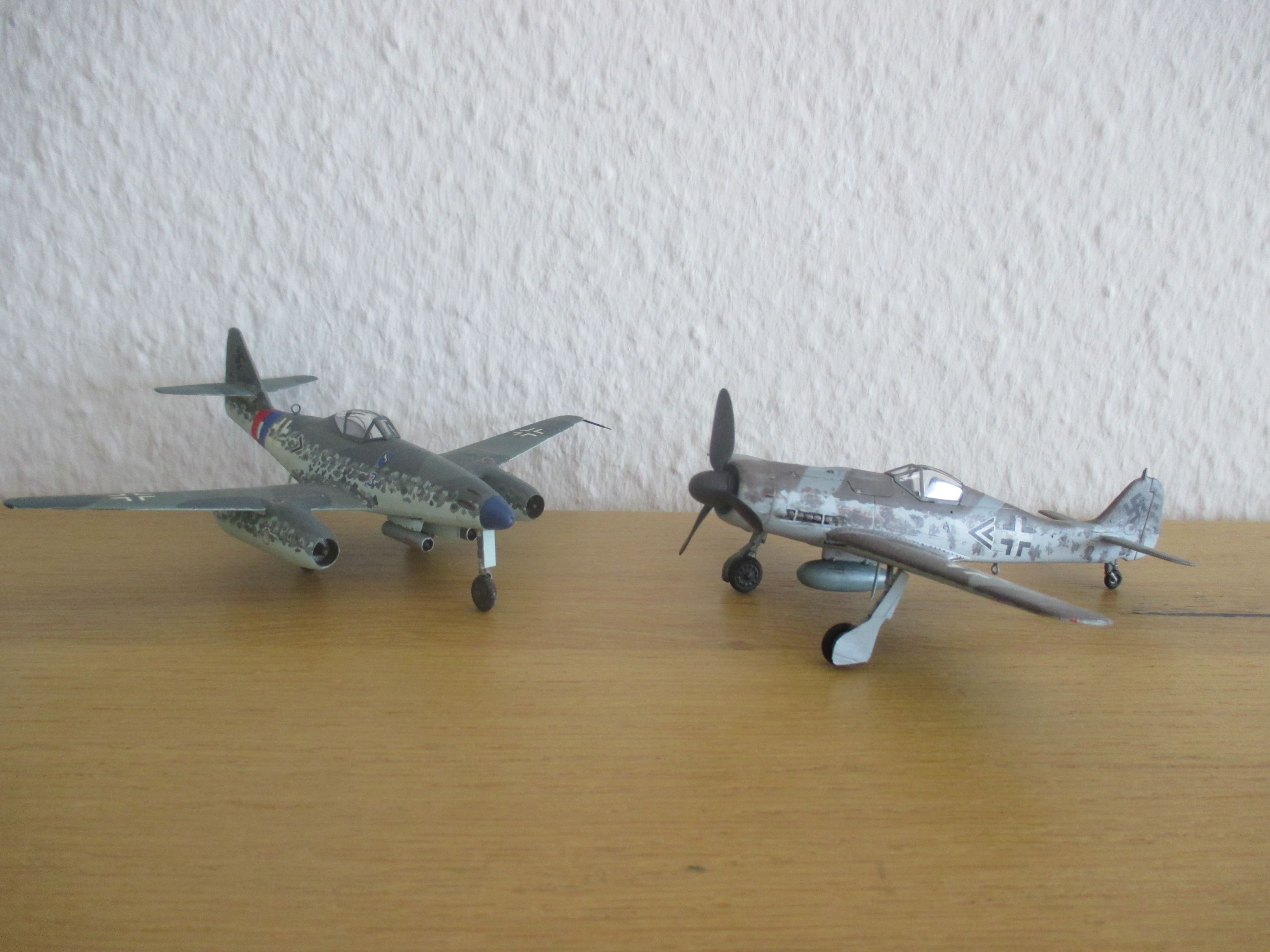
In addition to a restored Focke-Wulf 190 A-8, the Aviation Museum displays faithful miniatures of all series of this outstanding fighter aircraft in various scales in its model exhibition. Here we present the miniature of a Fw 190 D-9 – in a special paint scheme and mission – as our “Model of the Month”...
The model
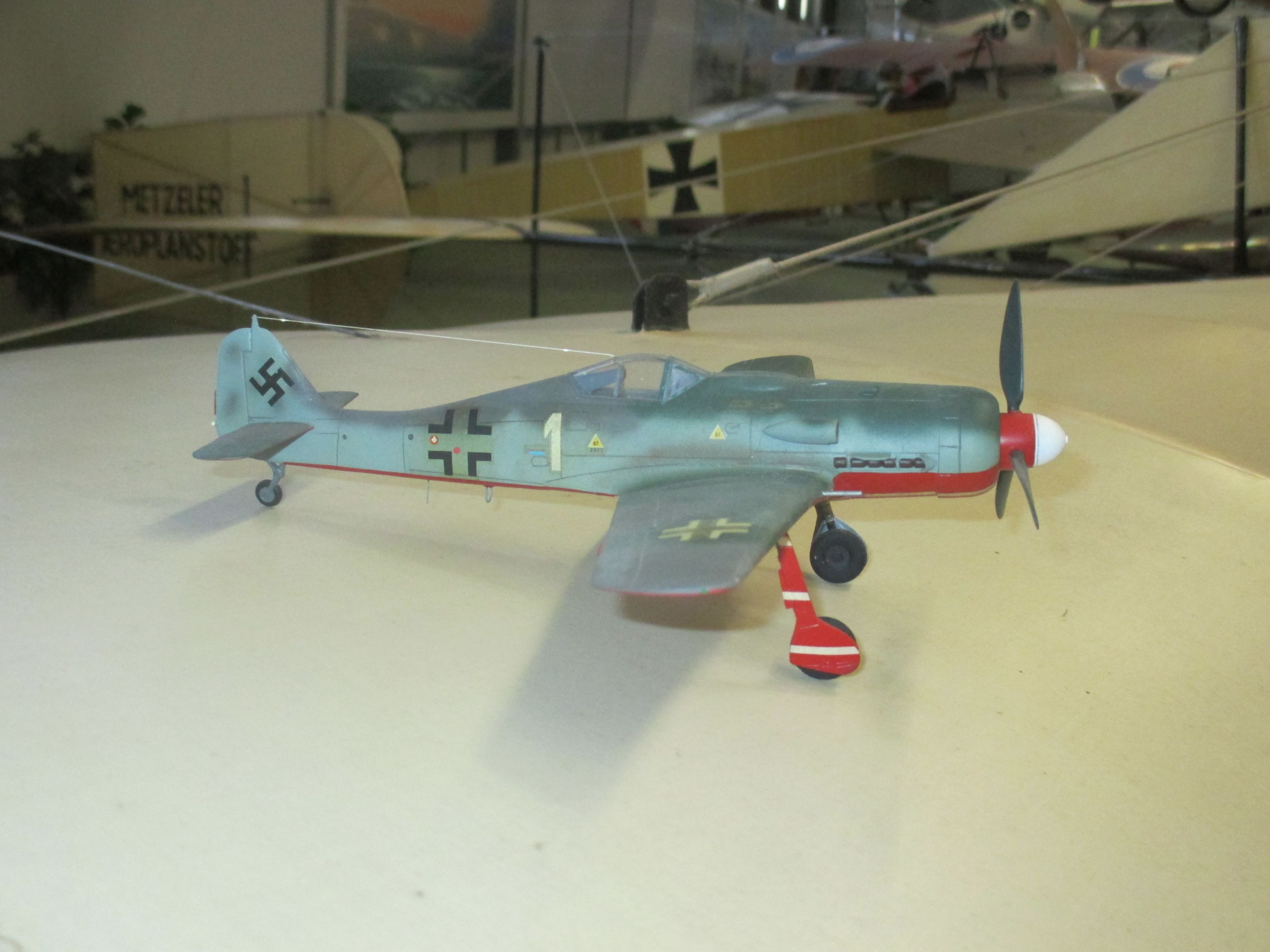
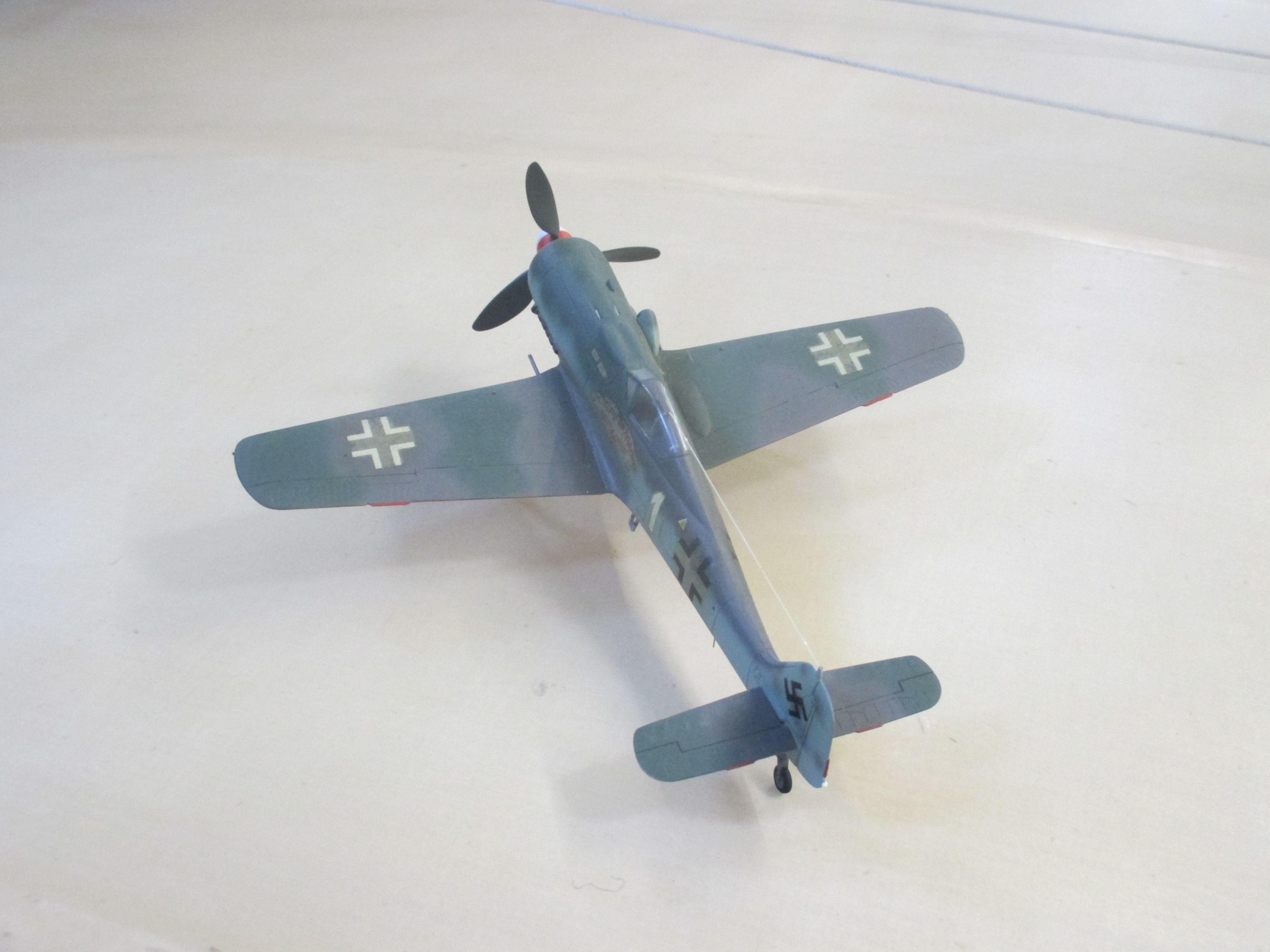
Built by museum association member Wilfried Lassoff, the model represents one of the five aircraft of the ‘Sachsenberg Swarm’, whose task was to secure the Me 262 A of Fighter Wing 44 during take-off and landing.
The kit, produced in first-class quality by Japanese manufacturer Tamiya, allows for impressive detailing in 1/48 scale despite the model's manageable size.
The model of the 190 D-9 shown here bears the ironic motto ‘Im Auftrag der Reichsbahn’ (On behalf of the Reichsbahn) on its fuselage, a reference to past missions against British and American fighter-bombers that attacked the Reichsbahn's freight and passenger trains.
The original
The ‘J.V.44’ (Jagdverband 44) under the command of Adolf Galland – after his replacement as General of Fighters due to disagreements with the political leadership – brought together the best fighter pilots of the Luftwaffe on the best interceptor type of the World War for a primarily symbolic task. With rarely more than 12 aircraft operational at one time in the last three months of the war, the unit still achieved remarkable successes against the overwhelming superiority of the Allied air forces: The intended demonstration of the technical superiority of the Me 262 jet fighter and the correctness of Galland's strategic and tactical, armament and military positions in this regard to the Reich leadership, which had cost him his position.
Operating out of Munich and then Salzburg in the final weeks of the Second World War, Fighter Wing 44 was assigned five Focke Wulf 190 D-9 and D-11 aircraft for airfield defence, whose pilots, like those of the ‘262’, were personally selected by Galland. The task of this small group was to protect the jet fighters, which were vulnerable to Allied fighters and fighter-bombers during take-off and landing. The unit, named the ‘Sachsenberg Swarm’ after its commander, Lieutenant Sachsenberg, operated at altitudes of only around 500 metres and was tasked with fighting the Americans' P-51 Mustangs and P-47 Thunderbolts, acting as bodyguards, so to speak, close to the ground for the ‘262’, which was hardly endangered at a certain altitude and speed.
with Junkers inline engine.
As the Luftwaffe's most powerful piston-engine fighter, this JuMo 213 A-powered Fw 190 of the D series was the aircraft of choice for that ‘suicide mission’. This was because operations were carried out with minimal warning times in crowded airspace controlled by the enemy – under enemy fire as well as their own anti-aircraft guns, making a life-saving parachute jump at operational altitudes virtually impossible...
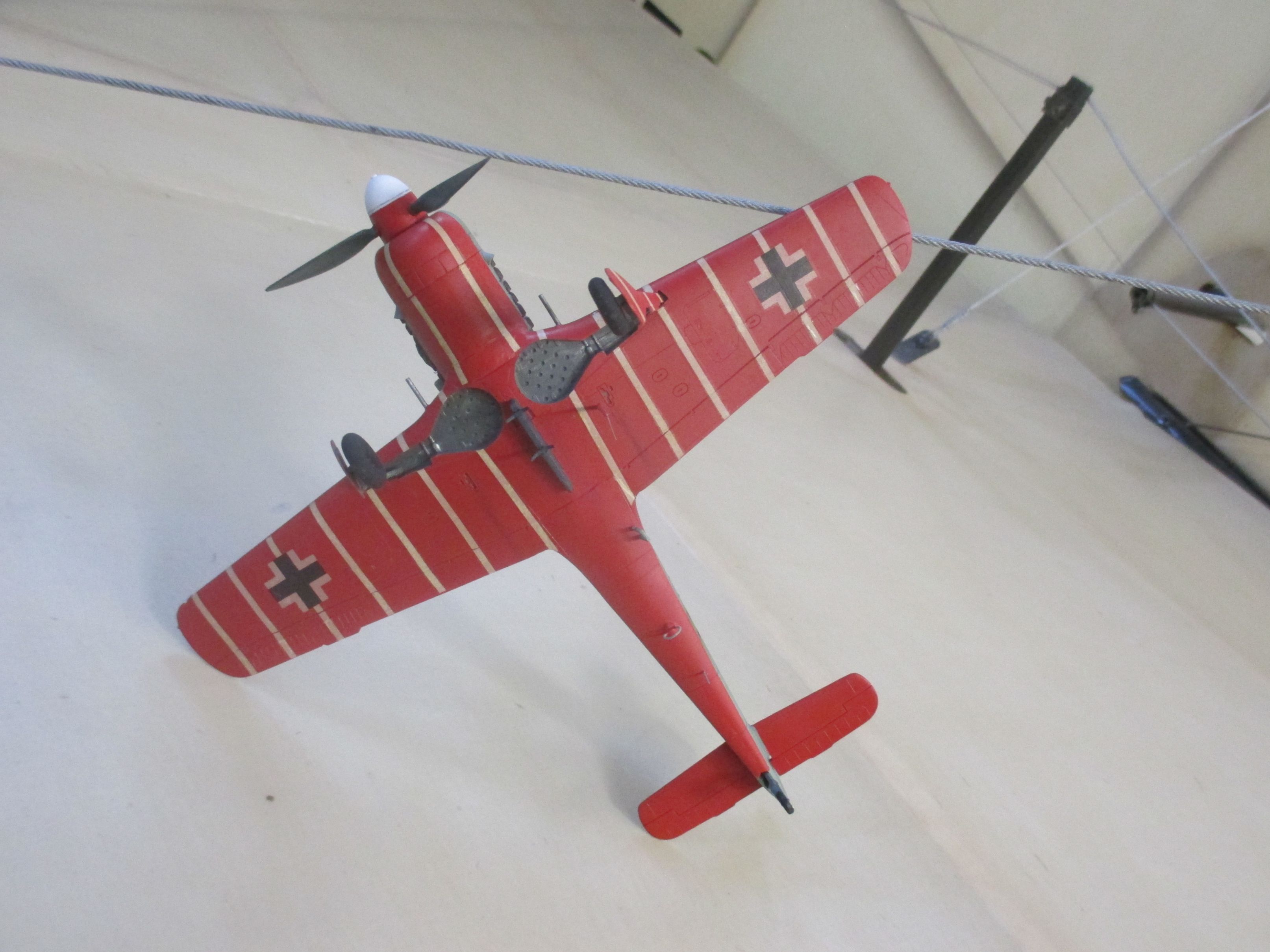
To enable the anti-aircraft guns to distinguish friend from foe, the undersides of the 190s in the airfield protection squadron were painted bright red with white stripes, which earned the group the nickname ‘Parrot Squadron’ after the war.
Fw 190 D-9 data sheet
Length 10.20 m, wingspan 10.50 m, empty weight 3,180 kg, take-off weight 4,636 kg, power 1 x JuMo 213 A 12-cylinder in-line aircraft engine with 1,750 hp (with injection briefly 2,100 hp), maximum speed 686 km/h, range approx. 810 km, armament 2 x MG 151/20 (20 mm MK) and 2 x MG 131 (13 mm MG), crew 1, number built in the D series 1,805, in service from October 1944 to May 1945, followed by testing and troop service with various victorious powers.
Welcome!
Have we sparked your interest in our collections, which include over 40 original and faithful replicas of gliders, light, commercial and military aircraft, twice as many engines, hundreds of pieces of equipment and our model collection? Then we look forward to seeing you at Ulmer Straße at the Hannover Exhibition Centre: See you there!
sb
You can contact the author of the Model of the Month series here: Autor-MdM